SSSS on a boarding pass: why the enhanced screening?
The letters **SSSS** on a boarding pass stand for *Secondary Security Screening Selection*. They indicate that the traveler has been selected for additional security screening before boarding under US aviation-security procedures. The marker does not automatically mean denied boarding, does not prove that you have done anything wrong and is not, by itself, evidence that you are on a watchlist. The boarding pass does not reveal the exact reason for selection.
What does SSSS mean exactly?
SSSS is associated with an enhanced-screening result. Under the US Secure Flight program, airlines submit certain passenger information to the Transportation Security Administration (TSA). The system returns a result used when a boarding pass is issued.
A report by the Department of Homeland Security (DHS) Office of Inspector General identifies SSSS as the enhanced-screening code printed on a boarding pass. It is an operational security marker, not a public explanation of the reason for selection or a note freely added by a check-in agent.
The letters may be displayed prominently or repeated on a paper boarding pass. Selection may also coincide with an inability to obtain a boarding pass online. That problem alone, however, does not prove SSSS selection. Airlines require in-person check-in for many other reasons, including passport, visa or entry-requirement checks.
Why were you selected?
The honest answer is often: you cannot tell from the boarding pass. The authorities do not publish detailed criteria that would let a traveler link an individual selection to one specific cause.
Separate official information from assumptions commonly repeated online:
| Level of information | What can reasonably be said |
|---|---|
| Confirmed | Secure Flight processes identity and travel information and can return a result requiring enhanced screening. |
| Confirmed | Travelers can also be selected for additional screening unpredictably or at random. |
| Cannot be inferred | The printed code does not say whether selection arose from a name match, a random check or another factor. |
| Frequently suggested, but unproven in an individual case | Late purchase, cash payment, a complex itinerary, a one-way ticket, travel involving certain countries or recent booking changes. |
Need help with airline vocabulary? Travel document. Browse the full air travel glossary.
These situations are regularly mentioned as possible factors, but the TSA does not publish a rule establishing that a one-way ticket, late purchase or particular itinerary automatically triggers SSSS.
Does SSSS mean that you are on a watchlist?
No. The SSSS code does not establish that you are on a watchlist. Some selections can be random or unpredictable. Secure Flight uses different screening elements, and a name match or identity-verification issue may also require additional checks. The precise reason does not appear on the boarding pass.
SSSS and the No Fly List are different situations:
| SSSS | No Fly |
|---|---|
| Additional security screening | A separate instruction that may prevent boarding |
| Travel generally remains possible after screening | The relevant journey may not be authorized |
| Can include random selection | Operates through a different mechanism |
| The code alone does not reveal the reason | Distinct from a simple SSSS marker |
The marker alone therefore cannot tell you whether a person is or is not recorded in any particular database.
What should you do right away?
Stay calm and go promptly to the security checkpoint or the location indicated by the airline. If you are already at the airport:
- keep your passport and boarding pass within easy reach;
- organize your cabin baggage so that it can be opened easily;
- follow the officers’ instructions and ask for clarification when necessary;
- tell an officer if boarding time is approaching, without assuming that the screening can be shortened.
There is no single official duration for SSSS screening. Allow more time than for a standard departure and start the security process as early as possible.
What happens during SSSS screening?
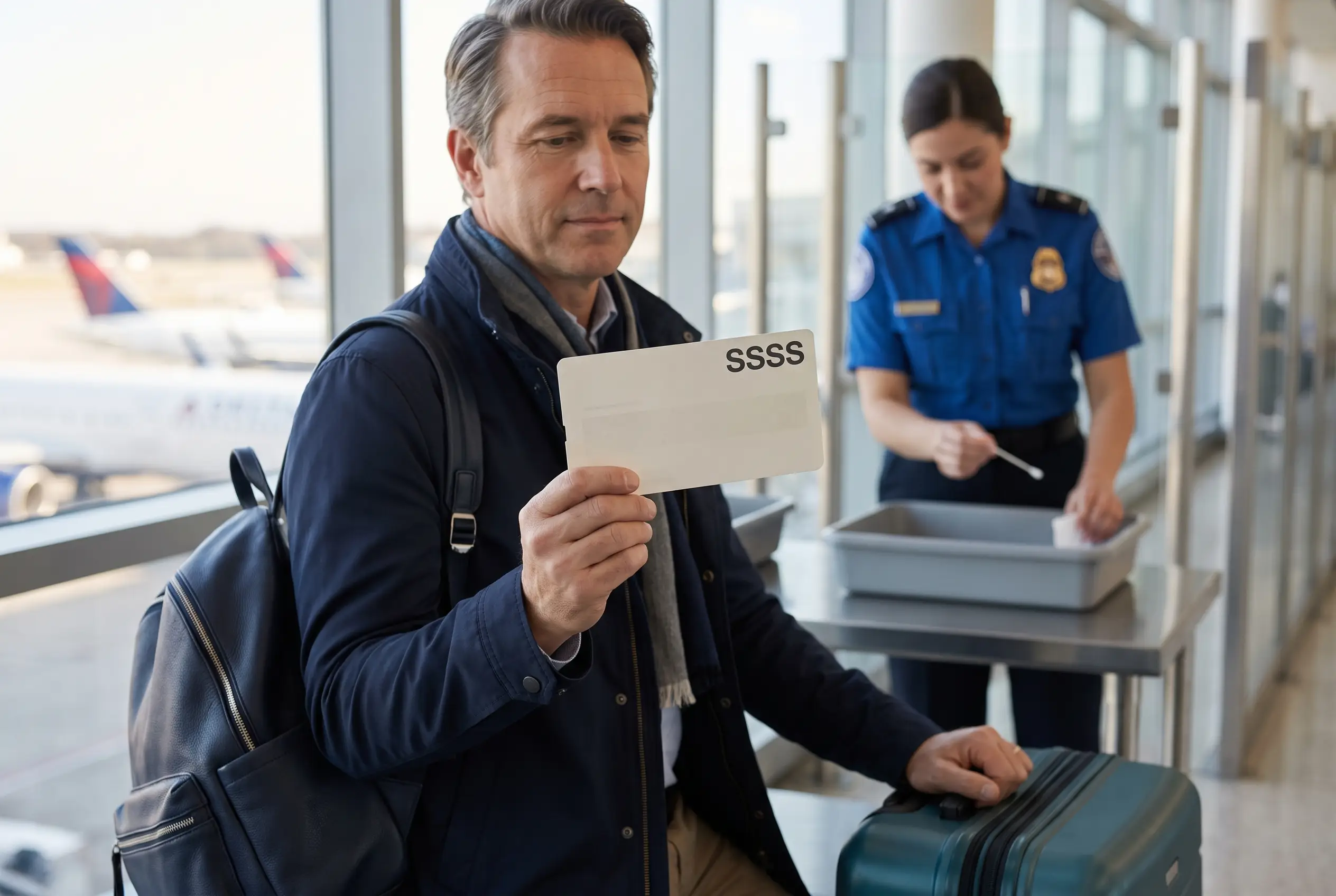
The exact process varies. Enhanced screening may involve:
- a more detailed identity and travel-document check;
- a manual search of cabin baggage and selected items;
- separate inspection of electronic devices;
- a pat-down;
- explosive-trace testing on hands, clothing or belongings;
- questions about the itinerary or baggage.
Not every measure is used for every passenger. Officers apply the procedure required for the screening result and the circumstances they encounter.
Cooperating does not prevent you from asking what is happening. You may ask an officer to repeat an instruction, disclose a medical condition, request a private pat-down or explain that an item needs careful handling. The available arrangements depend on the airport and responsible authority.
On which flights can SSSS appear?
The marker is connected with US aviation-security procedures. It can appear on certain flights within the United States, on international flights to the United States and on other itineraries that fall within the applicable scope of Secure Flight.
A boarding pass printed in France, Canada, elsewhere in Europe, Asia or another region can therefore carry SSSS when the flight is covered by these procedures. SSSS is not a universal security code applied identically in every country.
How can you reduce the risk of missing your flight?
If you see SSSS before departure, allow a larger margin than you ordinarily would. Check the airline’s and airport’s instructions because generic advice cannot replace their check-in and boarding deadlines.
These practical steps can reduce avoidable delays:
- download or print your itinerary and travel documents;
- make sure the reservation name matches your passport;
- remove prohibited items from your cabin baggage in advance;
- keep medication, liquids and devices organized;
- do not bury essential documents at the bottom of a suitcase;
- when possible, leave shopping and meals until after screening.
If the airline also requests a return ticket or proof of onward travel, that is a separate issue. Read our guide to a return ticket requested at check-in to prepare the right document without confusing an immigration requirement with a security screening result.
Does SSSS mean you will be denied boarding?
No, not automatically. SSSS means that additional screening is required. In many cases, the traveler boards after completing the process.
An actual denial of boarding may have a different cause: inadequate travel documents, late arrival, a ticketing problem, a separate security instruction, unmet entry requirements or an operational decision. If the airline ultimately refuses transport, ask for the precise reason.
Does the airline decide to add SSSS?
Airline staff process the passenger and issue the boarding pass, but the Secure Flight screening result is returned within the TSA system. SSSS is therefore not simply a discretionary choice made by an employee at the counter.
The airline remains the point of contact for operational matters such as printing the pass, check-in deadlines, the boarding gate or rebooking after a missed flight. To identify the documents it issues, see the difference between a PNR, e-ticket and boarding pass.
What if SSSS appears on every trip?
A single selection does not necessarily call for further action. If screening recurs, you are regularly unable to print a boarding pass, or an apparent identity mix-up repeatedly delays your travel, DHS offers a redress program: the DHS Traveler Redress Inquiry Program, or DHS TRIP.
Applications are submitted through the official portal. You describe the difficulties and provide the requested documents. Once the case has been processed, DHS may issue a Redress Control Number. You can enter it in future reservations to help the relevant systems associate your redress record with your identity.
The process does not guarantee that all additional screening will stop or that every future journey will be delay-free. It provides a formal way to request review of a recurring problem and, where possible, correct inaccurate information or identity confusion.
Before applying, retain:
- travel dates, flight numbers and airports;
- boarding passes displaying SSSS;
- relevant airline messages;
- a factual description of the screening or denial experienced;
- the identity documents requested by the official portal.
Do not send sensitive documents to an unidentified intermediary. Use the official DHS TRIP website.
SSSS and proof of onward travel are different checks
SSSS concerns aviation security. Proof of onward or return travel is used to show that a traveler has a plausible journey out of a destination. The latter may be checked by an airline at check-in or by border authorities.
Both situations can arise during the same trip, but one does not resolve the other. An onward reservation will not remove SSSS screening. Completing enhanced security screening does not waive visa, entry or exit-document requirements.
To compare acceptable evidence, read our guide to proof of onward travel at the airport.
Need proof of onward travel for your next trip? Prepare your ExitPass. Proof of onward travel can never remove or prevent SSSS screening.
Official sources
- DHS Office of Inspector General — TSA Needs to Improve Monitoring of the Secure Flight Program
- Department of Homeland Security — Privacy Impact Assessment for Secure Flight
- TSA — Travel Tips and security screening
- DHS TRIP — Frequently asked questions and redress application
- Department of Homeland Security — DHS Citizen Application Directory
Last editorial review: August 30, 2026.
FAQ
What does SSSS mean on a boarding pass?
SSSS stands for *Secondary Security Screening Selection*. It indicates that additional security screening is required before boarding.
Does SSSS mean that I am on a blacklist?
No. The code alone cannot establish whether your identity appears in a particular database. Selection may, among other possibilities, be random or connected with an identity check.
Why do I have SSSS on my ticket?
The boarding pass does not state the reason. Secure Flight can require enhanced screening, but the detailed criteria applied to an individual case are not public.
Can SSSS be assigned at random?
Yes. Additional screening can be random or unpredictable, so the marker should not automatically be interpreted as a personal accusation.
Can you receive SSSS with TSA PreCheck or Global Entry?
Yes. Membership in a trusted-traveler program does not guarantee the absence of additional screening on every trip. Follow the route shown on the boarding pass and the officers’ instructions.
Why can’t I check in online?
SSSS can coincide with a boarding pass being issued only at the counter, but many non-security issues can also block online check-in. The marker on the boarding pass or explicit information is needed to confirm selection.
Can SSSS appear at a European airport?
Yes. It can appear on a boarding pass for a flight subject to US procedures, including a flight to the United States. Screening can be organized under the arrangements in place at the departure airport.
Can I refuse additional screening?
You may ask questions and explain your needs, but refusing a required security check may prevent access to the secure area or boarding. Precise rights and procedures depend on the location and responsible authority.
Does SSSS remain attached to my passport?
The boarding pass does not reveal the selection logic. A single occurrence cannot predict future trips. If it keeps happening, document the incidents and consider DHS TRIP.
Will changing my ticket remove SSSS?
There is no guarantee. Changing or buying another ticket is not an official redress procedure and may create costs without removing the screening requirement.